
Key Engineering Takeaways
- Hot/cold aisle containment and Free-Cooling are critical to reducing the PUE (Power Usage Effectiveness) metric to 1.2 and below.
- High-density AI servers generate 30-50 kW of heat per cabinet; In-Row and liquid cooling are inevitable instead of traditional room air conditioners.
- Transformerless IGBT modular UPS systems provide up to 96.5% efficiency even at partial loads (40-70%).
- Sustainable data center design amortizes CAPEX investment with declining OPEX expenses within 2-3 years.
1. Energy Efficiency in Data Centers and the Importance of the PUE Metric
PUE formula: Total Facility Power / IT Equipment Energy
The efficiency scorecard of a data center is measured by the globally accepted PUE (Power Usage Effectiveness) value. In an ideal scenario, the PUE value is 1.0; meaning all energy entering the facility is directly transferred to the servers and no loss is experienced in auxiliary systems like cooling or lighting. However, the average PUE of a typical data center worldwide is around 1.55.
This indicates that for every 100 kW of IT power, approximately 55 kW of energy is wasted on cooling, fans, and power conversion losses. Given high electricity costs, reducing the PUE value from 1.5 to 1.2 translates to millions of liras in operational savings annually.
Calix Technology reports the instantaneous power consumption and losses of each rack cabinet with millisecond precision through energy monitoring software (DCIM) and smart power distribution units (PDU).
2. Revolution in Mechanical Cooling Architectures: In-Row and Free-Cooling
Cooling close to the heat source minimizes airflow speed and fan consumption.
Traditional under-raised-floor blowing CRAC systems cannot prevent the formation of 'hotspots' in high-density modern server rooms. The mixing of cold air with hot air before reaching the server causes compressors to overwork.
In-Row cooling units are placed directly between server cabinets. As soon as hot air exits the back of the server, it is captured by the In-Row unit, cooled, and immediately blown to the front of the cabinet. This reduces the air circulation path to a few meters, dropping fan energy consumption by up to 35%.
Free-Cooling technology deactivates compressors when the outdoor temperature drops below 15°C, integrating outside air into the cooling cycle via a heat exchanger. In Turkey's climate conditions, it is possible to benefit from Free-Cooling between 3,000 to 4,500 hours a year.
| Cooling Architecture | Applicable Cabinet Density | Average PUE Contribution | ROI |
|---|---|---|---|
| Raised Floor (CRAC) | 3 - 5 kW / cabinet | 1.6 - 1.8 PUE | Traditional / Low Efficiency |
| In-Row Close Cooling | 10 - 25 kW / cabinet | 1.25 - 1.35 PUE | 18 - 24 Months |
| Aisle Containment + Free-Cooling | 20 - 40 kW / cabinet | 1.15 - 1.25 PUE | 12 - 18 Months |
3. Smart Aisle Containment Strategies
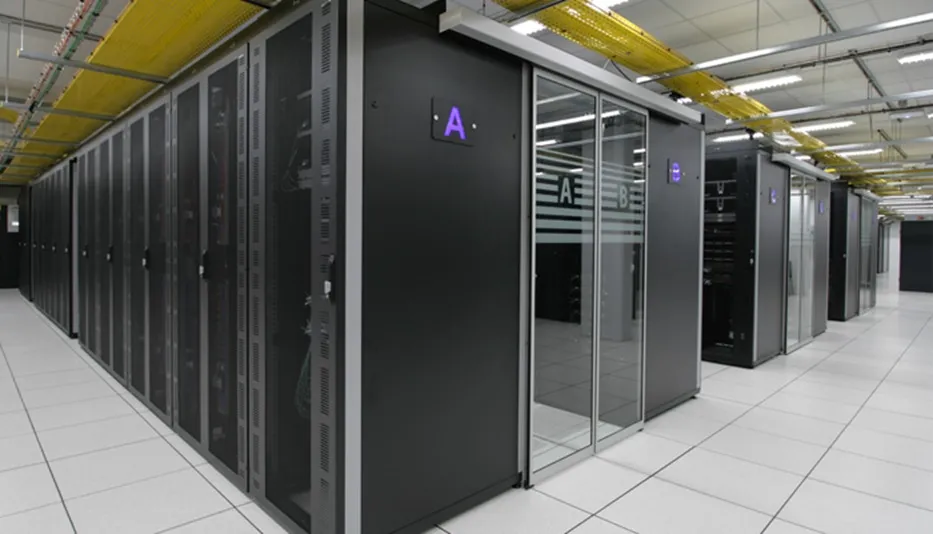
Hot Aisle Containment (HACS) vs Cold Aisle Containment (CACS)
Aisle containment systems completely prevent the mixing of hot exhaust air and cold supply air with physical polycarbonate or glass barriers. Thanks to this isolation, the air conditioning blowing temperature can be increased from 18°C to 24°C. Every 1°C increase in blowing temperature provides about 4% net energy savings in the chiller.
In the Hot Aisle Containment (HACS) architecture, the hot air behind the servers is directed to the air conditioner directly over a closed chimney or ceiling plenum. Since the rest of the room remains cool, a comfortable workspace is provided for operators, and fire detection systems operate more stably.
- Air Tightness: In-cabinet air leaks must be eliminated with Subzero brush cable pass-throughs and blanking panels.
- Automatic Fire Opening: When gas extinguishing systems are activated, aisle ceiling panels should release magnetic locks, allowing the gas to fill in.
- Modular Expansion: As new rack cabinets are added, the aisle structure should be able to expand without disruption.
Frequently Asked Questions (FAQ)
Does reducing the PUE value in a data center extend hardware life?
Yes. Precision air conditioning and aisle containment systems that lower PUE prevent server processors from being exposed to thermal fluctuations. Constant temperature and humidity values prevent fan failures and solder fatigue, extending hardware life by an average of 30%.
Can Calix Technology make improvements in currently operating data centers without downtime?
Absolutely. Modular aisle containment, In-Row cooling augmentation, and smart PDU transitions can be applied step-by-step (Hot-Retrofit) while live operations continue.
Let's Bring Your Project to Life
Discover the most suitable technology and infrastructure solutions for your needs with our expert engineering team.